
Organisation Redesign by Design, Not by Default
Organisation redesign has become the norm. Done well, it strengthens the business and its people; done poorly, it costs both. Five practical practices for the people side.
Organisation redesign, often simply called a restructure, has become the norm right now. Markets shift, cost programs land, AI adoption changes the work, and the structure follows.
Do you notice teams carrying the work of people who have left? Do you notice roles quietly changing shape, or reporting lines moving? Do you notice managers answering questions their briefing hasn't covered yet? And do you notice teams needing new capability while the organisation itself keeps evolving? These are the everyday signs of a redesign in progress.
A redesign run well and a redesign run poorly are two very different businesses.
A redesign run well and a redesign run poorly are two very different businesses, and the difference is rarely about the restructure itself. People rarely leave the redesign; they leave the way it was run. Gartner's research on change fatigue makes the same point in numbers: only 43% of employees experiencing high change fatigue say they intend to stay, compared with 74% when fatigue is low. When a redesign wears people down, they leave, and the knowledge and the clients leave with them. Run it well and the payoff is just as real: Deloitte finds skills-based organisations are 98% more likely to hold on to their high performers.
The redesign is public; the people side is not.

The redesign itself happens in the open, and retail shows it first. The June quarter brought 254 Australian retail insolvencies, and KPMG expects the pressure to last until the end of 2027. The survivors are redesigning too: Woolworths' annual report calls it "support office simplification", everyday language for the same work with fewer people. Hotels are on the same road, with the big groups trimming corporate roles as functions centralise globally. Even Asia-Pacific, where retail spending is growing about 5% a year, is redrawing structures rather than protecting them.
What stays private is the people side. Managers carry the heaviest part of it: Gallup now finds people managers reporting more daily stress than the people they manage. On an ordinary Tuesday it is the store manager fielding "what does this mean for my job?" with nothing official to share. When someone hands in their notice, it is rarely one bad week; it is the sum of extra shifts, unanswered questions and no visible future.
Safe Work Australia's national code lists poor organisational change management among the psychosocial hazards employers must manage. How you run the change is now part of workplace safety.
Redesign by design, not by default
Here is the frame I keep coming back to.
“Redesign is now part of running a business, not a one-off event.
The org chart changes whether anyone designs it or not.
The only real choice is redesign by design, or redesign by default and hope.”
I work through the same four lenses every time: capability, structure, leadership and culture. Capability simply means the skills and strengths your people already have. The lenses never change; the moves inside them change with every case, and that is what makes them usable. You can hold any redesign, in any business, up against these four lenses.
And capability appears twice in the five practices for a simple reason: in a redesign, your people spend their strengths to carry the change, and the change itself is what builds their next strengths. That is also why a redesign can give people a future, not just a new structure.
Five practices, in the order a redesign happens
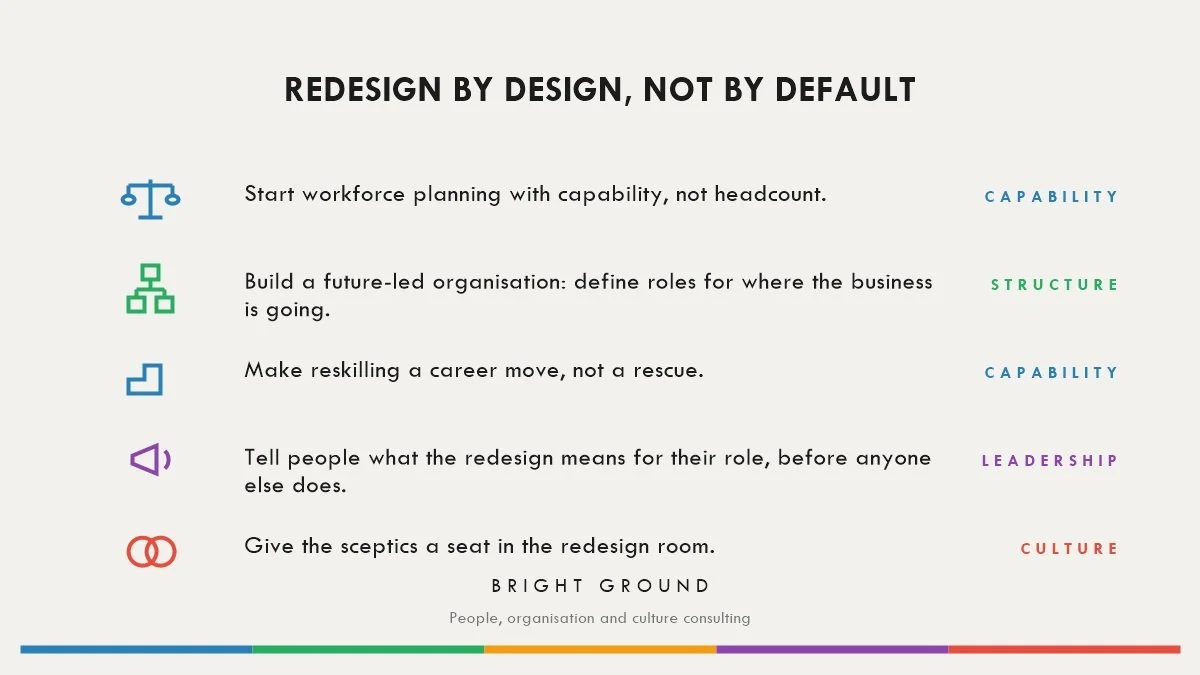
5 practices
1. Start workforce planning with capability, not headcount.
An org redesign should not start with this question: “How many roles do we need?” Count the capability first and the roles last during workforce planning. When the counting happens three floors away from where the capability lives, the person who held the customer relationship nobody recorded is the one who goes. Know the strengths of your people, redeploy them into more valuable work, and only then count the roles.
In practice: a one-page capability picture of every team — what each person is genuinely good at, not their title — built before any role-count decision; redeployment before redundancy.
2. Build a future-led organisation, so people see themselves growing with you.
A role written for yesterday's store guarantees the next redesign. Roles defined for where the business is heading do two jobs: they shape the structure, and they let people see a future in it. A role that points somewhere is a reason to stay; a role that only describes today is a waiting room.
In practice: write each role for the business eighteen months out, one page, naming the capability it needs most; if it only makes sense inside today's structure, redesign it before you fill it.
3. Make reskilling a career move, not a rescue.
One person hears "your job is changing, here is a course". Another hears "we are building the new format and we would like you to help run it". Same course, entirely different career. Framed as a move rather than a lifeline, it becomes your strongest retention enabler.
In practice: every person whose role changes gets one named conversation about where they are heading, and leaves it with one next step that has a date.
4. Tell people what the redesign means for their role before anyone else does.
Silence is never neutral in a redesign; it gets filled with the worst interpretation, usually over coffee in the break room. Gartner finds employees are 4.3 times more likely to trust senior leaders who explain their decisions. Explaining is half the work. The other half is listening, because what comes back shapes the redesign itself.
In practice: one plain-language line per role group — what changes, what doesn't, what it means for you — said by each person's manager, with a question channel that visibly gets answers.
5. Give the sceptics a seat in the redesign room. Resistance is information, and involvement turns critics into explainers.
Your loudest sceptic is the cheapest risk review you will ever run. The people questioning the redesign usually see the holes in the plan before anyone else. Inviting them in surfaces risks while they are still small, and it changes the floor: the person who asked why in the tea room starts explaining the decision to their mates.
In practice: two or three respected sceptics join the design review before decisions lock, and you publish what changed because of what they raised.
The org chart will keep changing; that is the market at work. What it cannot decide is whether your best people are still in the business when it settles. Structures are redesigned in quarters. Trust is redesigned in conversations while the structure moves.
Dorothy Liu · Founder, Bright Ground
Sources: Gartner · KPMG · Woolworths Group · Safe Work Australia · Deloitte · Hotel News Resource
Keep Reading: Leadership integration brings new leaders together as one team
